
Peer review for ideas, not people.
Independent AI lenses read the same text, disagree on the record, and produce a cited recommendation — then a human Chair decides. Every report is sealed and verifiable.
Already have a workspace? Sign in →
F-0002 F-0004 F-0007; “clinically proven” is unsupported F-0003. Chair: human · mode: human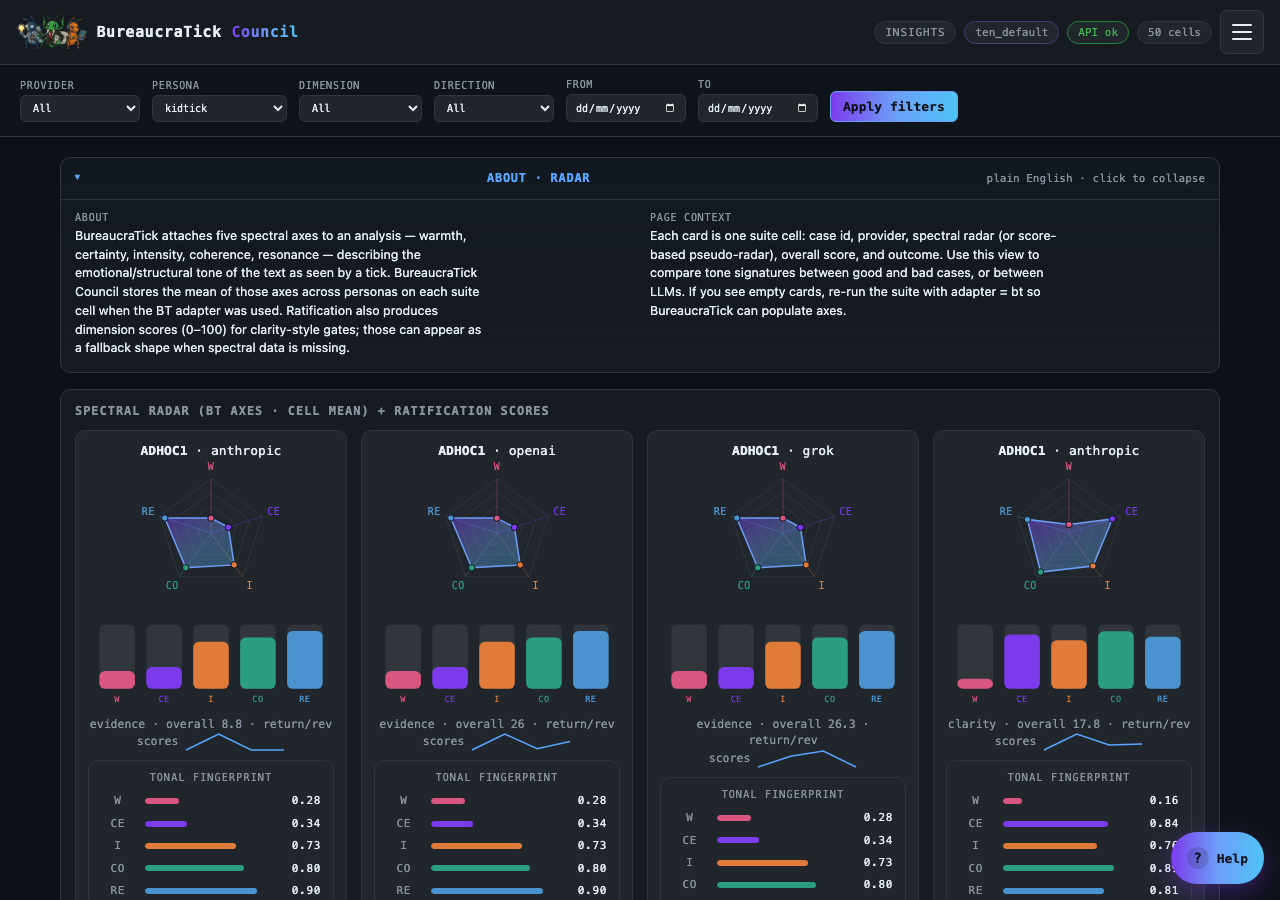
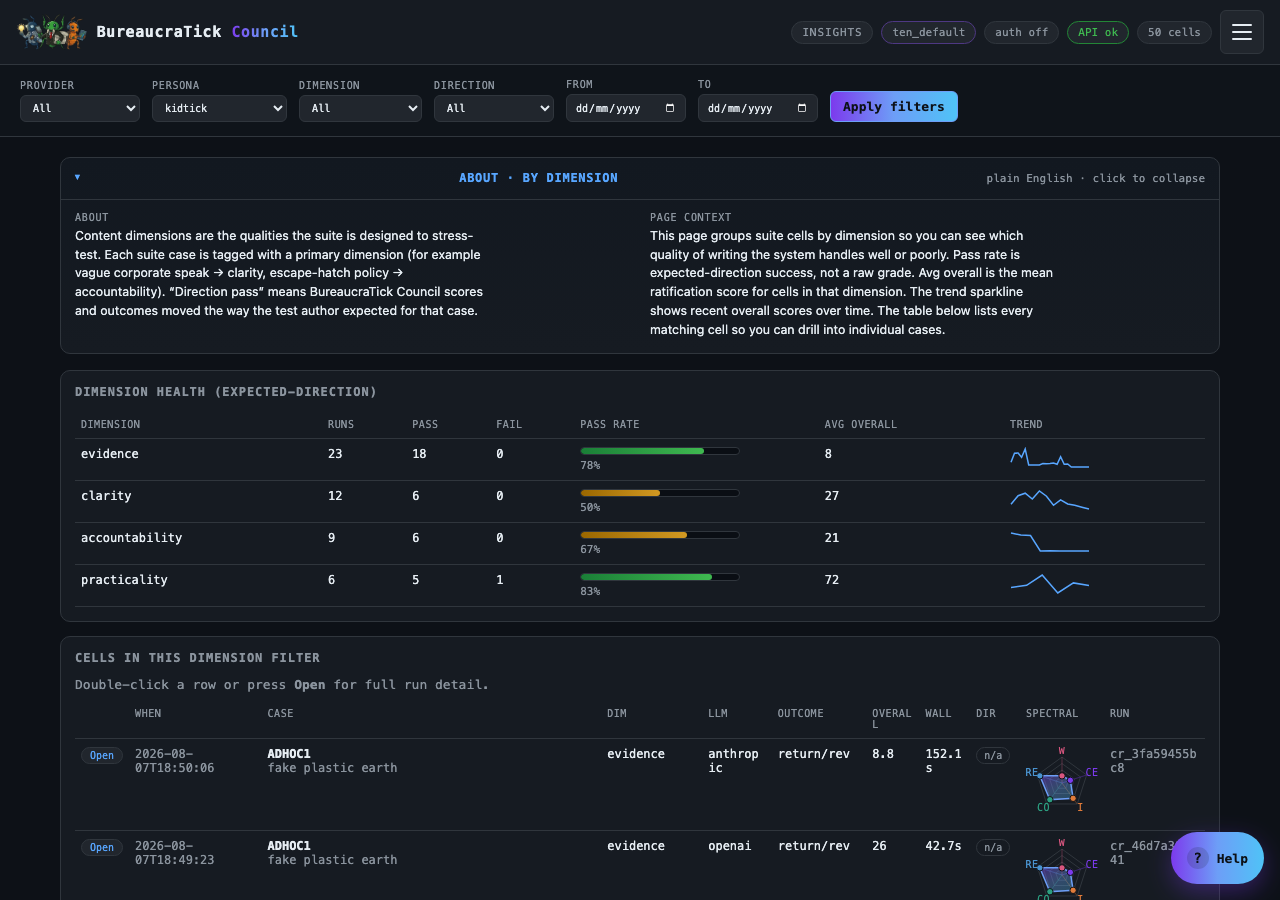
Single-answer AI hides its assumptions.
One model, one voice, one verdict — and no record of what was weighed or who dissented. For policy, postmortems, marketing claims and anything a regulator or board might ask about later, that is not a decision you can defend.
Council makes the disagreement part of the output.
Each persona submits structured findings independently. Findings are pooled, clustered into formal issues, debated in bounded rounds, and turned into a recommendation that cites its evidence. Minority views are preserved, not averaged away. A human Chair ratifies — or doesn't.
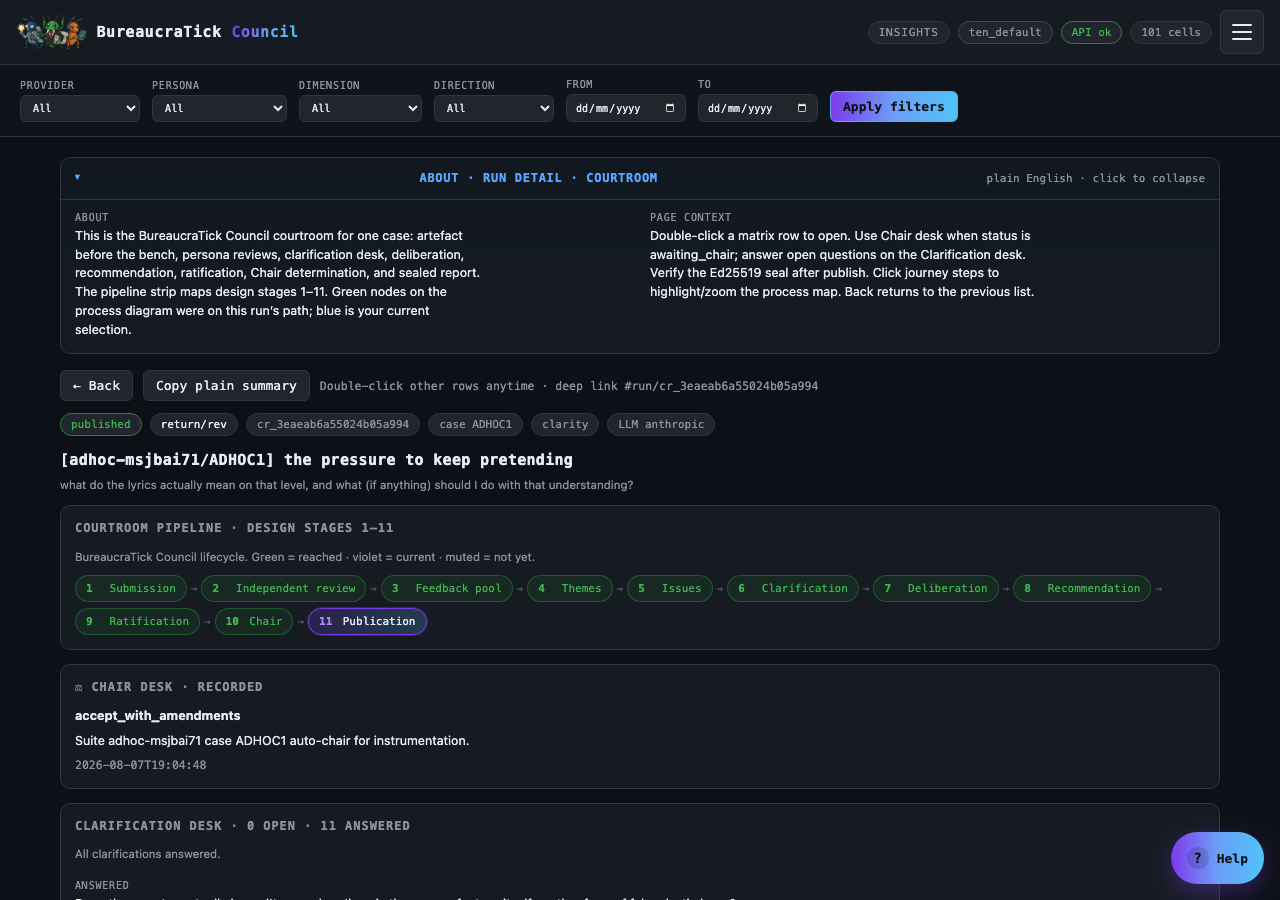
Six stages. Every one of them on the record.
an artefact and a review question.
each persona reads alone and returns structured findings (stance, concerns, strengths, questions, lens limits).
findings are pooled and clustered; material disagreements become formal issues.
issue-by-issue, round-limited, every move logged.
cited to findings and issues; uncited assertions are counted, not hidden.
a human accepts, amends, or returns for revision; the report is signed (Ed25519) and anyone with the link can verify the seal without seeing the content.
Each persona has a declared role, primary question and known blind spot.
You can see all three — on every review and in every report.
What does the text actually say, without a specialised lens?
Who owns this, by when, and what happens if not?
What do these words actually promise?
Does the evidence support the claim?
What is the downside, and can it be undone?
Can this actually be done as written?
How will a sceptic read this?
Base Mode's spectral axes are a numeric anchor; its prose is model-default judgment — we label it that way on every report.
Packs — what you'd actually use it for.
A pack = seated personas + chair criteria + thresholds + a regression suite.
Technical / research claim
Evidence and first-principles integrity.
Run the sample →Incident postmortem / RCA sign-off
Evidenced timeline, named owners, honest recurrence risk, reversible actions.
Run the sample →Marketing claims / compliance
Every claim read literally, evidenced, read back as a sceptic would, scored for regulatory risk.
Run the sample →The report is the product.
- algorithm
- ed25519
- sha256
- a6b4bda6…92def48
- key
- sha256:9785f4ed…
- verify
- /verify/cr_3eaeab6a…
Marketing claims — AuraSleep launch copy
Collective recommendation
Return for revision. F-0002 F-0003 F-0004 F-0007
Residual minority view
SarcasTick: the headline is defensible if the footnote becomes the headline. F-0011
Chair decision
return_for_revision (mode: human) — “Substantiate or remove ‘clinically proven’ before resubmission.”
- CitedRecommendation lines carry finding ids; uncited assertions are counted in the open.
- Honest about its instrumentsSpectral axes are shown as tonal evidence with their scoring path, never as “deterministic” unless they are; auto-chair (test harness) decisions are banner-labelled non-binding.
- Verifiable
/verify/<run_id>confirms the seal for anyone, revealing hashes and timestamps only.
Built for integration.
- REST with OpenAPI
/v1/openapi.json, tenant-scoped; session login or machine API keys. - SDKsTypeScript (
@bureaucratick/council-sdk, zero deps) and Python (bureaucratick-council, stdlib only). - Webhooks & meteringHMAC-signed run events; idempotency keys; usage + quality metering per tenant.
import { CouncilClient } from "@bureaucratick/council-sdk";

const council = new CouncilClient({ baseUrl: DEMO_URL, apiKey: process.env.BTC_API_KEY });
const run = await council.reviews.create("ten_sandbox", {
  council_template: "marketing_claims_v1",
  artefact: { type: "text", content: copy },
  review_question: "Can this be published as-is?",
  wait: false,
});
const done = await council.reviews.waitFor("ten_sandbox", run.run_id);
const html = await council.reviews.reportHtml("ten_sandbox", run.run_id);
# create (async) …
curl -X POST $DEMO_URL/v1/tenants/ten_sandbox/reviews \
-H "Authorization: Bearer $BTC_API_KEY" -H 'content-type: application/json' \
-d '{"council_template":"marketing_claims_v1","artefact":{"type":"text","content":"…"},"review_question":"Can this be published as-is?","wait":false}'
# … then the sealed report (markdown | html | json)
curl $DEMO_URL/v1/tenants/ten_sandbox/reviews/<run_id>/report?format=html \
-H "Authorization: Bearer $BTC_API_KEY"Trust, in specifics.
- Human Chair is the final authority; the system recommends, it does not determine. Every Chair decision is attributed and timestamped.
- Tenant isolation, per-tenant policy (allowed providers, persona caps, rate limits) and metering.
- Reports sealed with Ed25519; seal verification is public; stored reports are hash-checked against the seal on every export.
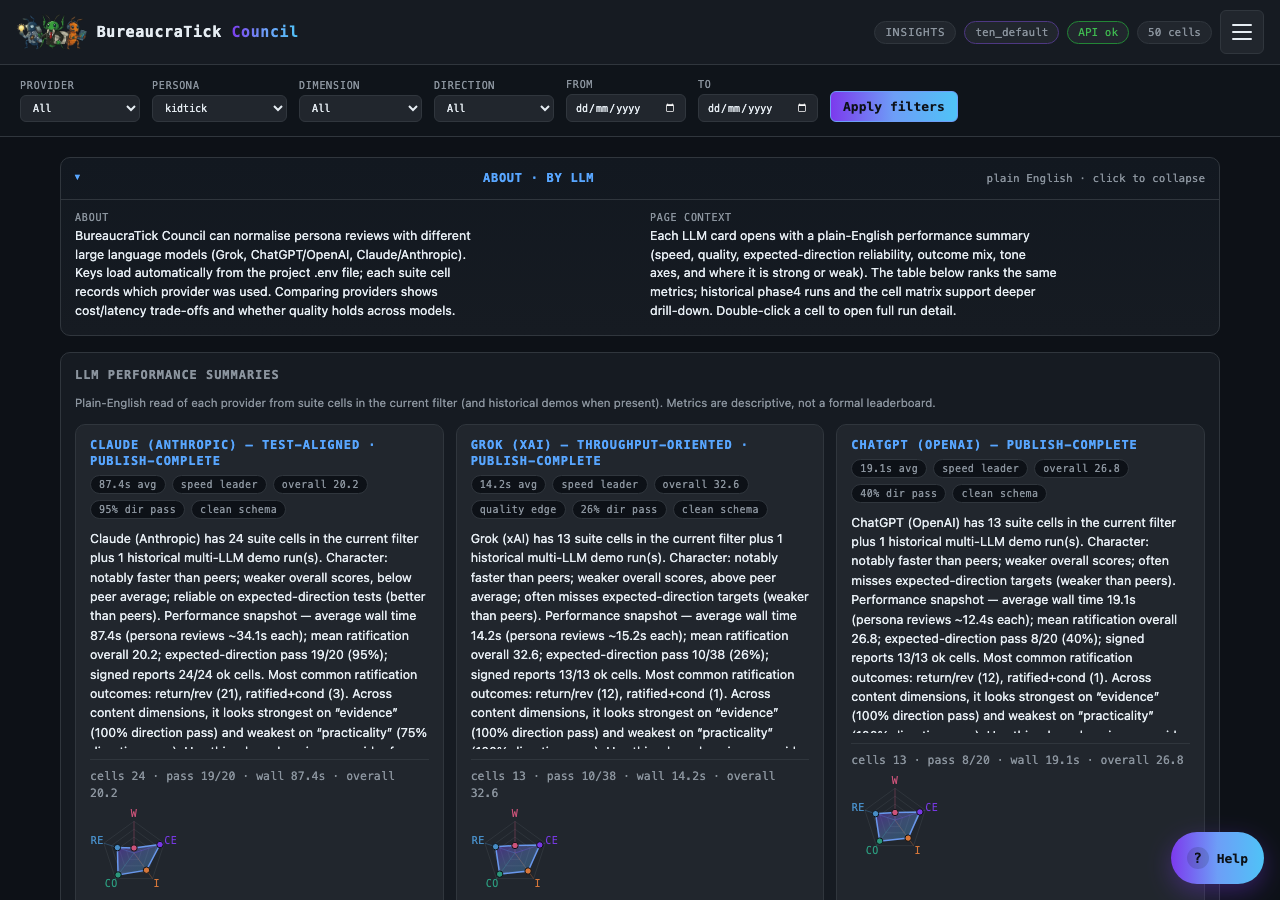
- Multi-provider by design (xAI, OpenAI, Anthropic); provider and model are recorded per persona review.
- Quality is instrumented: structured-output failure rate, clarification rate, human-override rate and time-to-decision are first-class metrics in the product.
Put a real document in front of the Council.
Pilots run on your artefacts, in your tenant, with your Chair. We set up the pack, you bring the text.